
















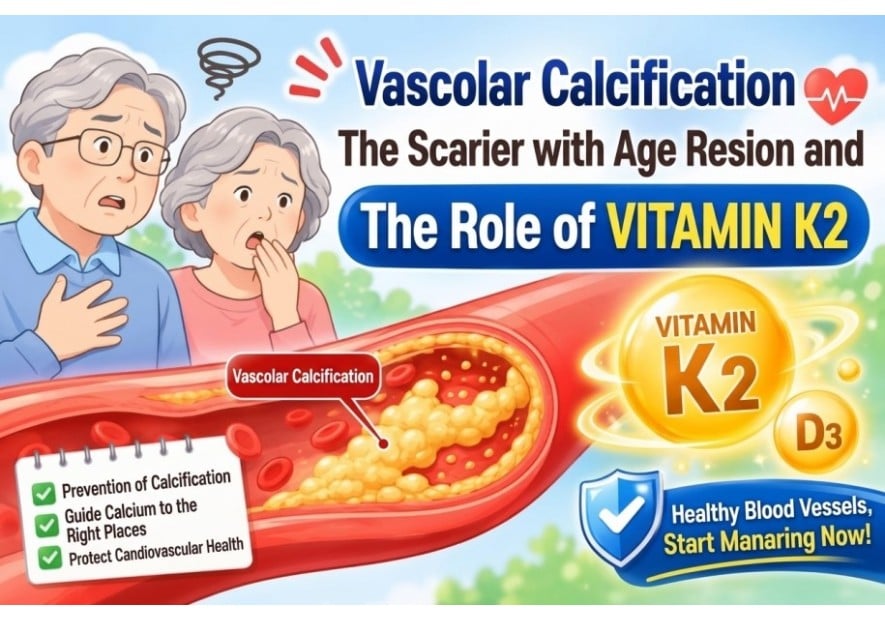

Vascular Calcification, Why It Becomes More Dangerous with Age and the Role of Vitamin K2
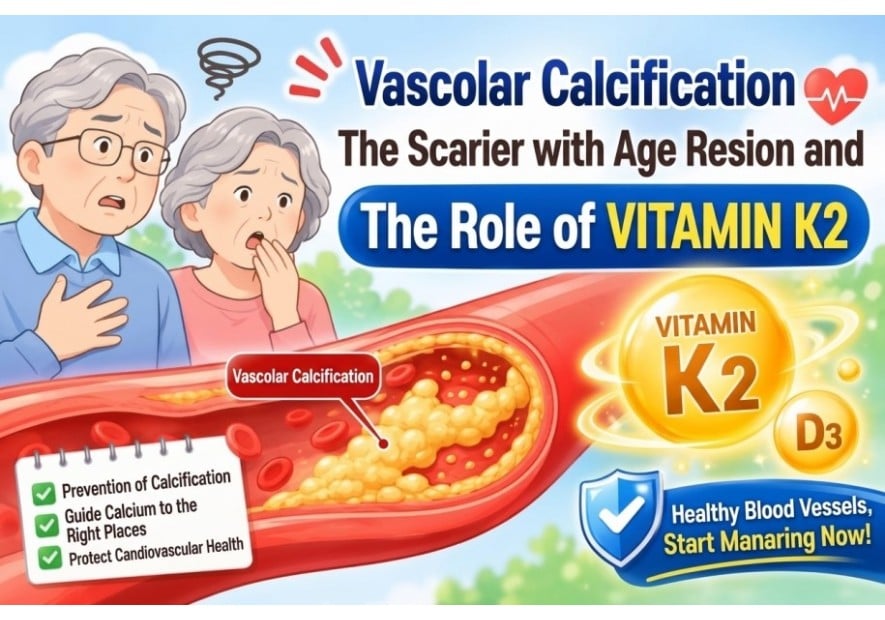
As we age, we often pay close attention to our blood pressure or cholesterol levels, yet many remain unaware of "vascular calcification"—the accumulation of calcium within blood vessels. In health check-up reports, "coronary artery calcification" is one finding that often raises concern. Did you know that the calcium you consume to strengthen your bones can sometimes end up accumulating in your blood vessel walls instead, causing them to harden? Vascular calcification acts like a dangerous "ticking time bomb," gradually stripping the body of its elasticity and posing a serious threat to cardiovascular health. Recently, however, the medical community has identified "vitamin K2" as a promising key to countering this "silent killer." Research suggests that vitamin K2 activates proteins involved in calcium metabolism, helping to inhibit the deposition of calcium within blood vessels. In this article, we will explore why vascular calcification becomes an increasing concern with age, and examine the potential—as well as the limitations—of vitamin K2, as revealed by the latest clinical research.
What Is Vascular Calcification? Why Do the Heart and Blood Vessels Become More Vulnerable with Age?
Vascular calcification is a phenomenon in which substances like calcium and phosphate accumulate in the walls of blood vessels, altering their structure and function. It is known to occur more frequently with advancing age. This condition is not simply the result of high calcium intake; rather, it is a complex process involving factors such as atherosclerosis, chronic inflammation, and the aging of vascular cells. As calcification progresses within the vessel walls, the vessels lose their elasticity and become rigid, which can impair blood pressure regulation and place additional strain on heart function. Coronary artery calcification—the accumulation of calcium in the arteries that supply blood to the heart—is a particularly significant indicator for assessing the future risk of cardiovascular disease. It is important to note that vascular calcification may not present any noticeable symptoms until it has reached an advanced stage. Therefore, as we age, it is wise to pay attention not only to blood pressure and cholesterol levels but also to overall vascular health. This includes undergoing regular check-ups to objectively assess the state of one’s blood vessels and taking proactive steps to prevent the silent, progressive aging of the vascular system.
The Key to Directing Calcium to the Right Place: How Vitamin K2 Works
In the human body, calcium is an essential mineral for maintaining strong bones and teeth; however, if it accumulates abnormally in the walls of blood vessels, it can compromise vascular health. Vitamin K2 (menaquinone) has recently gained attention for its role in this process. Vitamin K2 exists in various forms, such as MK-4 and MK-7—with MK-4 primarily found in animal-based foods, while MK-7 is abundant in fermented foods like natto and remains in the body for a relatively longer period. The primary function of Vitamin K2 is not to remove calcium directly from the bloodstream, but rather to activate proteins involved in calcium metabolism. One such key protein, Matrix Gla-Protein (MGP), is activated through a process called carboxylation—a step facilitated by Vitamin K2. Once activated, MGP effectively inhibits the abnormal deposition of calcium in arterial walls. While Vitamin D3 supports gut and bone health by overseeing the absorption of calcium from the digestive tract, Vitamin K2 acts as its perfect partner, ensuring that the absorbed calcium is directed to the right places rather than accumulating in blood vessels. Prominent epidemiological research, including the Rotterdam Study, has indicated that individuals with a sufficient intake of Vitamin K2 show a significantly lower risk of aortic calcification and cardiovascular disease.
Vitamin K2 and the Inhibition of Vascular Calcification: Evidence from 2026 Clinical Trials
Recent international scientific literature has provided increasingly robust evidence for the positive impact of Vitamin K2 on vascular health. While the role of Vitamin K2 in mitigating vascular calcification was previously understood primarily through biochemical mechanisms and animal studies, significant findings from clinical trials involving human patients emerged in 2026. According to the VitaK-CAC clinical trial—a study of 180 participants published in the June 2026 issue of the international journal *JAMA Cardiology*—high-dose supplementation with MK-7 alone slowed the progression of coronary artery calcification by approximately 29% compared to a control group. Furthermore, the large-scale DANCODE study, presented at the European Society of Cardiology (ESC) congress in August 2026, demonstrated that a combined regimen of Vitamin K2 and Vitamin D3 reduced the rate of calcification progression by approximately 21%. Both studies offer meaningful insights, suggesting that Vitamin K2 has the potential to decelerate the progression of coronary artery calcification. However, medical experts caution that these latest clinical findings should be viewed as a preventive measure—slowing the dangerous progression of the condition—rather than a definitive treatment capable of completely reversing or dissolving existing, hardened calcifications.
Conclusion
Vascular calcification, which progresses imperceptibly as we age, serves as an invisible threat to cardiovascular health. Vitamin K2—which helps direct calcium to the appropriate areas of the body rather than allowing it to accumulate in blood vessels—is a key factor in defending against this form of vascular aging. Recent clinical research, including studies featured in *JAMA Cardiology* and the DANCODE project, has scientifically demonstrated that Vitamin K2 can slow the progression of coronary artery calcification by approximately 20–30%. It is important to note, however, that this is a preventive approach aimed at slowing the process rather than a treatment to completely eliminate existing calcification; therefore, consistent management tailored to one’s individual health status is essential. Healthy blood vessels are not built overnight. As you age, remember that even small differences in your daily lifestyle habits can significantly influence your future cardiovascular health.
Frequently Asked Questions (FAQ)
Q. Can consistent intake of vitamin K2 eliminate existing vascular calcification?
A. There is currently insufficient clinical evidence to suggest that vitamin K2 can dissolve or remove existing vascular calcification. Ongoing research primarily focuses on its potential to slow the progression of calcification.
Q. Does taking vitamin D3 and K2 together provide a greater preventive effect against vascular calcification?
A. While vitamin D3 is involved in calcium absorption and K2 plays a role in activating proteins such as MGP—meaning the two nutrients serve complementary functions—it cannot be definitively stated that taking them together provides a superior preventive effect against vascular calcification.
Q. For vascular health, should I choose MK-4 or MK-7 (forms of vitamin K2)?
A. MK-4 and MK-7 differ in terms of their duration in the body and the required dosage. Although some recent clinical trials have utilized MK-7, it is difficult to conclude that one specific form is more effective for everyone.
source
1. Two Years of Menaquinone-7 Supplementation and Coronary Artery Calcification: A Randomized Clinical Trial (2026) Authors: Liv M. Vossen, Peter W. de Leeuw, Leon J. Schurgers, et al.
2. Vitamin K2 and D3 Supplementation in Patients With Severe Coronary Artery Calcification: The DANCODE Trial (2026) Authors: Selma Hasific, Kristian Altern Øvrehus, Anna Mejldal, et al.
3. Vitamin K and Vascular Calcification: From Biological Plausibility to Clinical Realism (2026) Authors: Clinical Kidney Journal
4. Vitamin K and Vascular Calcification (2021)- Authors: Jennifer S. Lees, Patrick B. Mark, Miles D. Witham.
5. Vitamin K-Dependent Proteins and the Role of Vitamin K2 in the Modulation of Vascular Calcification: A Review (2014)- Authors: Margueritta S. El Asmar, Joseph J. Naoum, Elias J. Arbid.

Leave a comment