










A Comprehensive Guide to Choosing Omega-3, Understanding EPA DHA Content, rTG, and IFOS Certification All at Once
Among the countless supplements we take every day, Omega-3 is an absolute essential. By what criteria are you currently selecting yours? You have likely been disappointed at least once after blindly buying a product thinking, "They must all be similar," only to experience an upset stomach due to a fishy smell or find the essential content woefully insufficient. Amidst the flood of advertisements and unfamiliar technical terms like rTG and IFOS (International Fish Oil Standards), it is by no means easy to identify a product that truly benefits your body. Therefore, today, I will simply summarize the key criteria for choosing the safest and purest Omega-3 without fail, amidst this deluge of information.
What Makes Good Omega-3 Different? Key Criteria You Must Know Before Purchasing
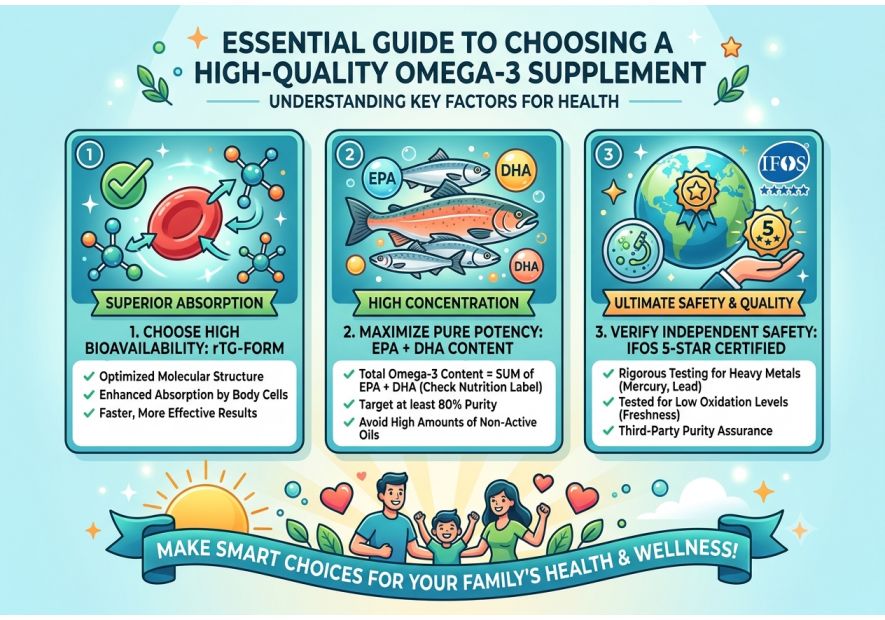
Among the countless supplements flooding the market, what exactly makes an Omega-3 truly beneficial for your body? If you open your wallet blindly, swayed by vague big-name brands or "cost-effective" advertisements, you are likely to end up choosing a product that is merely a supplement in name only and lacks nutritional value. You only need to remember three key points for choosing a fail-safe Omega-3. First, check if it is the rTG type, which maximizes absorption in the body through a structure similar to cell membranes; second, verify if it has received IFOS 5-Star certification, which proves the freshness of the raw materials and safety regarding heavy metals; and finally, check the actual content (EPA+DHA) that truly acts on the body. If you properly understand and compare these three selection criteria, you can find an Omega-3 product that you can confidently recommend to your precious family.
How to Check Pure EPA & DHA Content to Maximize Omega-3 Benefits
The most frequently overlooked aspect when choosing Omega-3 is the pure content of EPA and DHA. Even if 1,000mg is prominently displayed on the front of the product, the actual amount of EPA and DHA—essential for our bodies—may be significantly less. To avoid falling for the trap of marketing that emphasizes numbers alone, it is crucial to check the sum of EPA and DHA, rather than the total Omega-3 content. For example, even if a capsule contains 1,000mg, if it contains 300mg of EPA and 200mg of DHA, the actual core Omega-3 content is 500mg, and the purity is 50%. Only when the purity is 80% or higher can it be called a highly concentrated Omega-3 product. By simply knowing this calculation method, you can avoid being swayed by advertising slogans and make a much wiser choice for the Omega-3 that truly benefits your health.
Is rTG really better? Differences from EE and TG types
If you have researched Omega-3, you have likely heard at least once that rTG Omega-3 is superior. rTG refers to a form that maintains the natural TG structure while removing impurities, characterized by a high absorption rate. When comparing it to the existing TG and EE types, the EE type may have lower absorption rates due to processing, and the TG type, while natural, can sometimes have a lower degree of purification. Therefore, rTG Omega-3 can be considered a balanced form that captures both absorption rate and purity. However, rather than assuming that rTG Omega-3 is unconditionally the best, it is most important to choose based on the quality and purity of the raw materials, as well as your individual constitution and purpose of consumption.
Is I Really Need to Check for IFOS Certification? The Final Checkpoint for Choosing Good Omega-3
No matter how high the EPA and DHA content is or how rTG-type a product may be, it is difficult to consider it a "good" Omega-3 supplement if its quality and safety are not guaranteed. This is where IFOS certification comes in handy; it is a representative quality certification that inspects for heavy metals, rancidity, and purity according to international standards. IFOS is a global Omega-3 certification body that evaluates the contamination and freshness of raw materials with the strictest standards. If a product has received the highest rating of 5-Stars, you can consume it with confidence. If you consume rancid Omega-3 that has failed to meet standards, it can become a toxin that attacks cells rather than a beneficial supplement; therefore, you must check for this certification mark on the package before purchasing. Developing the habit of verifying quality certification one more time before selecting a product can be the final checkpoint for choosing a healthy Omega-3.
Conclusion
Ultimately, the secret to choosing a good Omega-3 lies not in the flashy advertisements on the packaging, but in having the eye to read the details hidden within the ingredient list. Please check just once to ensure it is the rTG type for rapid absorption, has a high pure content of EPA and DHA that truly act on the body, and is safe from heavy metals and rancidity risks through IFOS certification. From now on, I hope you will compare products based on objective selection criteria rather than just famous brands. I hope you use the three selection criteria I outlined today as a compass to give the gift of genuine, safe, and nutrient-rich Omega-3 to your precious body.
Frequently Asked Questions (FAQ)
Q:How much Omega-3 should I take per day?
A:For general health management, a combined daily intake of 250–500 mg of EPA and DHA is recommended. However, if the goal is to manage specific medical conditions, a higher dosage may be necessary, so it is advisable to consult with a doctor or pharmacist before consumption.
Q:Can I take it with Vitamin D?
A:Yes, it is fine to take Omega-3 and Vitamin D together; in fact, taking them with a meal can aid in the absorption of both nutrients. Taking them together after a meal containing fat is particularly beneficial for increasing absorption rates.
Q:Should I refrigerate it?
A:In most cases, it is sufficient to store it in a cool, dry place away from direct sunlight before opening. However, if you live in a hot and humid environment or plan to store it for a long period after opening, refrigeration can help slow down oxidation.
source:
www.oneclearwinner.ca / Ultimate Best omega 3s Guide
www.healthline.com / Omega-3 Supplement Guide: What to Buy and Why
www.careforhealthylife.com / Complete Guide to Choosing and Using Omega-3
www.fmfomega3guide.com / Omega-3 Supplementation Guide

Leave a comment