










The Truth About Supplements That Become Toxic When Taken Daily, High-Dose Ingredients to Avoid and Proper Intake Standards
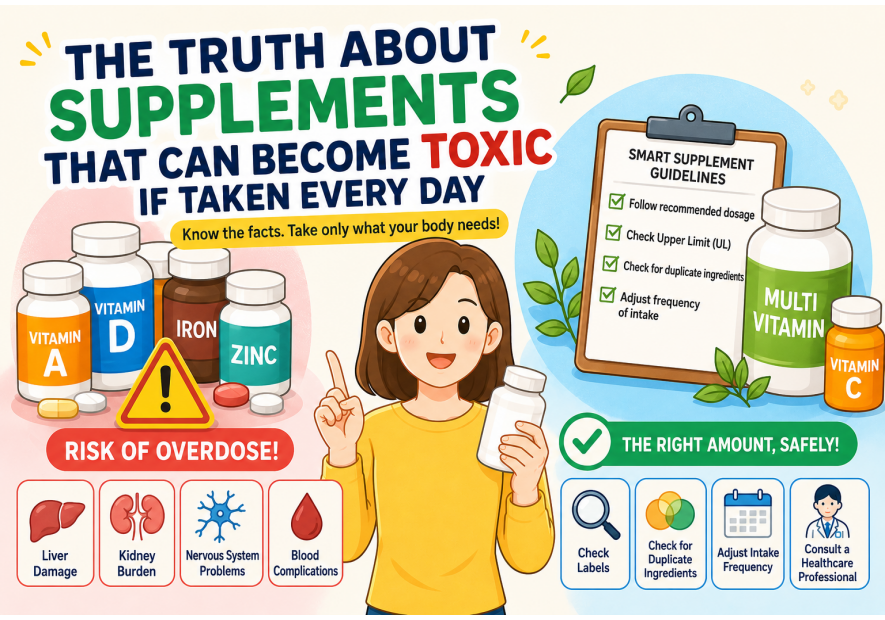
You diligently take supplements every day for your health; do you think that the more you consume, the healthier you will become? However, even essential vitamins and minerals can become a burden on your health if consumed in excessive amounts. In particular, when taking multiple types of supplements together, duplicate ingredients can occur, leading to unwitting high-dose intake. This is why you might wonder, "I am taking these for my health, but could they actually be toxic to my body?" In today's article, we will clearly outline the high-dose supplement ingredients that cause side effects when consumed thoughtlessly every day, as well as the intake standards to ensure safe consumption while protecting your body.
The Truth About Supplements That Become Toxic When Taken Daily: High-Dose Ingredients to Avoid and Proper Intake Standards
You diligently take supplements every day for your health; do you think that the more you consume, the healthier you will become? However, even essential vitamins and minerals can become a burden on your health if consumed in excessive amounts. In particular, when taking multiple types of supplements together, duplicate ingredients can occur, leading to unwitting high-dose intake. This is why you might wonder, “I am taking these for my health, but could they actually be toxic to my body?” In today's article, we will clearly outline the high-dose supplement ingredients that cause side effects when consumed thoughtlessly every day, as well as the intake standards to ensure safe consumption while protecting your body.
Supplement Ingredients That Can Be Dangerous to Take Daily
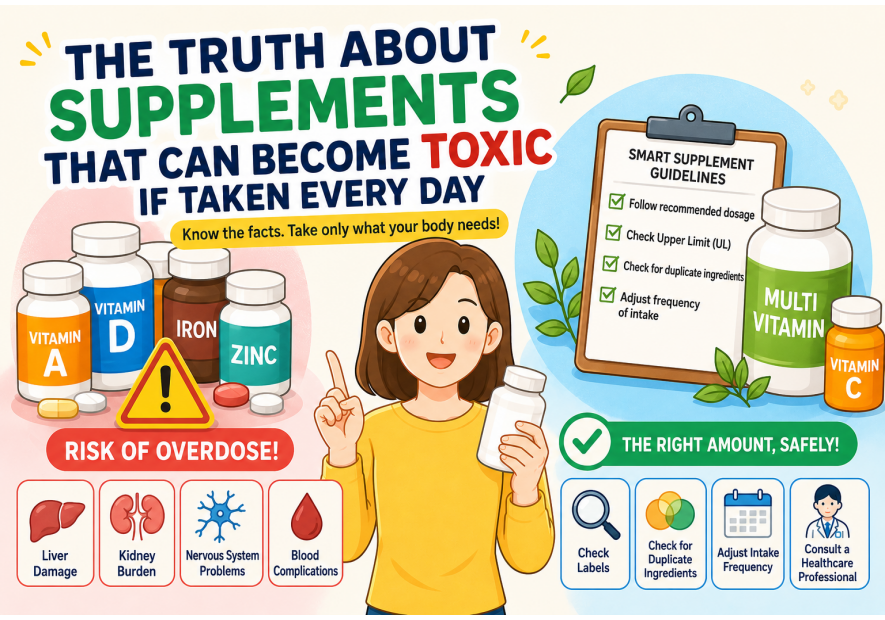
Among the supplements we take daily for our health, there are representative ingredients that can become dangerous if consumed in high doses over a long period, as they accumulate in the body. The first category consists of fat-soluble vitamins such as Vitamins A, D, E, and K; these are not easily excreted through sweat or urine and accumulate in the liver and fat, potentially causing toxic symptoms such as fatigue or liver damage. The second category involves high-dose minerals like iron, calcium, and zinc; exceeding the recommended dosage can lead to side effects, including gastrointestinal disorders, cardiovascular strain, and interference with the absorption of other minerals. Excessive calcium intake can be linked to conditions such as kidney stones, so it is necessary to monitor the total intake of both food and supplements. In particular, while Vitamin D is beneficial for bone health, excessive consumption can lead to hypercalcemia, and iron requires special caution as excessive accumulation in the body can easily cause organ damage. Ultimately, the important thing is not to identify "supplements to be avoided at all costs," but to consume the necessary nutrients in appropriate amounts.
Intake Patterns to Avoid: People Who Need Special Caution
Nutritional supplements are not equally safe for everyone, and precautions may vary depending on your health condition and medications you are currently taking. It is especially advisable to consult a specialist before taking supplements if you have liver or kidney disease, thyroid disease, or blood clotting issues. If you are taking anticoagulants, thyroid medication, or blood pressure medication, there is a possibility that certain supplements may affect the efficacy of your medication. During pregnancy or breastfeeding, you must be particularly careful about excessive intake of substances like Vitamin A or iodine, so it is safer not to arbitrarily select high-dose products. Additionally, if you are taking multiple types of supplements simultaneously, you must check to ensure that the same ingredients do not overlap. Adding a single vitamin without knowing the ingredients in a multivitamin can lead to an unwittingly high intake, so it is essential to verify that ingredients do not overlap. Therefore, it is important to choose supplements wisely based on your health condition and required dosage, rather than simply taking a large amount.
Proper Supplement Intake Guidelines to Protect Your Body Without Side Effects
When it comes to supplements, adhering to the appropriate dosage is far more important than the belief that "the more you take, the better." In particular, the upper limit of intake is a standard established to reduce the risk of health problems when consumed over a long period. When choosing a product, it is necessary to develop the habit of carefully checking the single serving size, daily intake amount, and dosage units such as mg and µg on the ingredient list. If you are taking both a multivitamin and a single nutrient, it is also important to add up the amounts of the same ingredient. Furthermore, not all supplements must be taken every day; the frequency of intake can be adjusted according to the ingredients and individual needs. However, you should not apply a method like taking them 3 to 5 times a week uniformly to all supplements; you must first check the recommended intake method for each product. Ultimately, the wisest approach is to consistently consume the necessary nutrients in the required amounts, within a safe range, and in accordance with the guidelines.
Conclusion
While nutritional supplements are a reliable aid for your health, consuming large amounts does not necessarily lead to better health. In particular, fat-soluble vitamins and certain minerals can accumulate in the body or cause side effects if consumed in high doses over a long period. Furthermore, taking multiple products together can lead to overlapping ingredients, potentially resulting in unwittingly high intake. Therefore, when selecting supplements, it is advisable to check the ingredient list and dosage, and to be aware of the difference between the recommended daily allowance and the upper limit of intake. If you have a medical condition or are taking medication, it is also important to consult with a professional to ensure the product is suitable for your situation. It is crucial to cultivate the small habit of carefully checking the ingredient lists of the supplements currently in your drawer and adjusting your intake according to your body's condition. I hope you build a truly healthy daily life without side effects by adopting safe and smart supplement intake methods that are perfectly suited to you.
Frequently Asked Questions (FAQ)
Q1. Since water-soluble vitamins are all excreted through urine even if consumed in large quantities, isn't it okay to take high doses?
A. While it is true that excess water-soluble vitamins like Vitamin C and B complex are excreted, taking them in excessive amounts places a significant burden on the kidneys and stomach during the excretion process. Since Vitamin C can cause kidney stones and Vitamin B6 can cause neuropathy, you must adhere to the appropriate dosage even for water-soluble vitamins.
Q2. Can I take multivitamins and single-nutrient supplements together?
A. It is possible, but you must check the total intake amount as the same ingredients may overlap. In particular, carefully examine the content of Vitamins A and D, iron, and zinc.
Q3. Is it okay to take multiple supplements at once?
A. Depending on the ingredients, there are combinations where taking them together can hinder absorption or increase side effects. For example, calcium and iron, or zinc and copper, interfere with each other's absorption, so it is safer to take them separately with time in between.
Sources:
1.Dietary Reference Intakes for Vitamin A, Vitamin K, Arsenic, Boron, Chromium, Copper, Iodine, Iron, Manganese, Molybdenum, Nickel, Silicon, Vanadium, and Zinc (2001)/ Authors: Institute of Medicine, Food and Nutrition Board, Panel on Micronutrients
2.The Role of Vitamin B6 in Peripheral Neuropathy: A Systematic Review (2023)
Authors: P. R. et al.
3.Vitamin D Toxicity—A Clinical Perspective (2018)/ Authors: Marcin W. Płudowski et al.
4.Evaluation of Documented Drug Interactions and Contraindications Associated with Herbs and Dietary Supplements: A Systematic Literature Review (2012)
Authors: H-H Tsai, H-W Lin, A. Simon Pickard, H-Y Tsai, G. B. Mahady

Leave a comment